

CarboNet chemistry is designed for solids-heavy aggregate wash water—dropping TSS in seconds, cutting polymer use by up to 80%, and keeping plants running with less tuning and downtime.

Aggregate wash water is a mighty mess of silica, silt, and clay that legacy polymers struggle to flocculate and settle. Whether it’s frac sand, construction aggregates, or quarry fines, crews often overdose as they try and wrestle PPM within range, driving up chemical costs, slowing down operations, producing wet sludge, and overloading settling ponds.
The details: Legacy chemicals are the core problem. Commodity coags don’t clarify enough and flocculants can’t settle fast enough. The results are felt throughout the site:
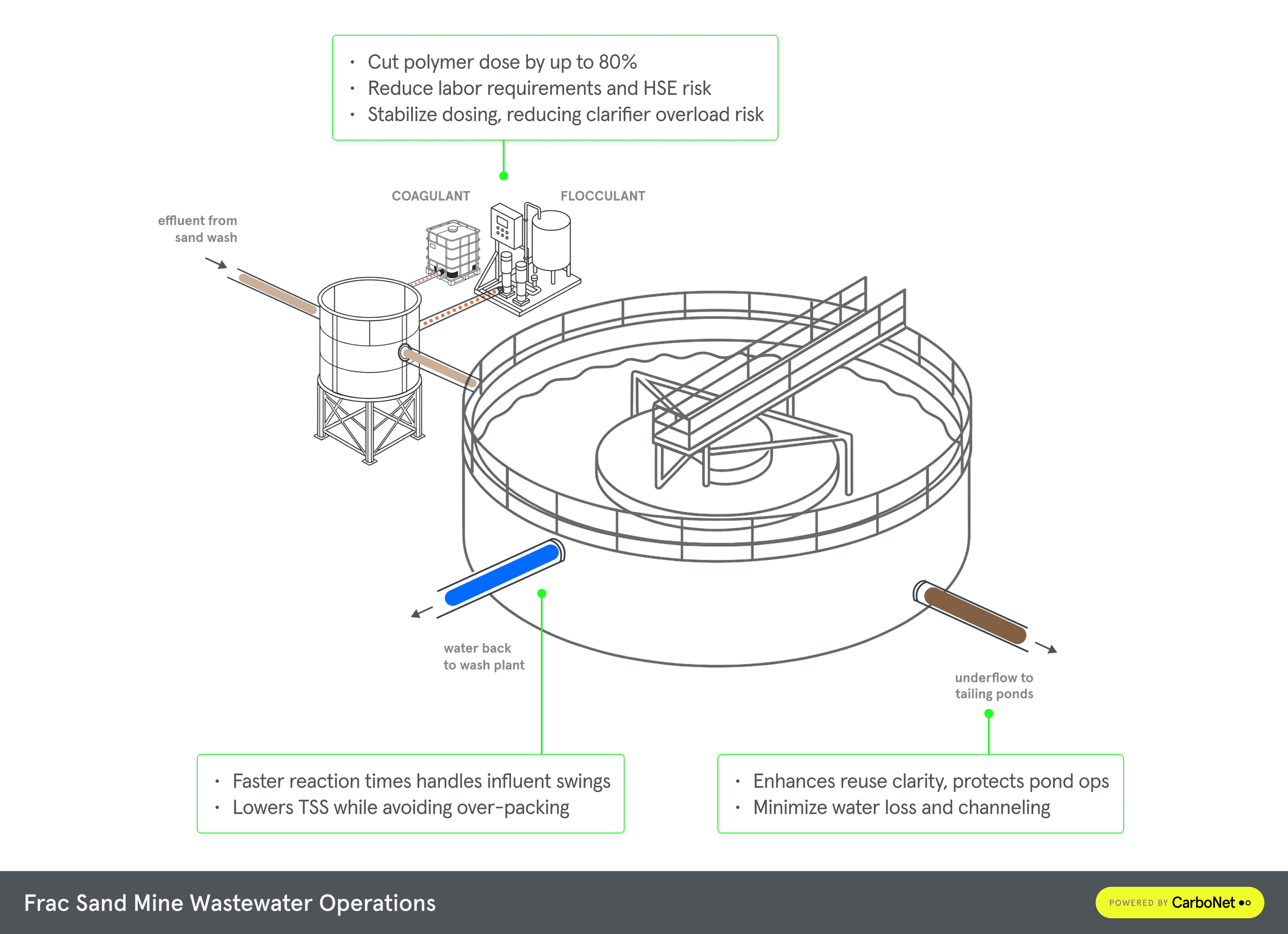
Solved with science: CarboNet chemistry is built to handle ultrafine particles and shifting water conditions, producing fast settling, clearer overflow, and stable performance without constant adjustment:
Behind-the-scenes: CarboNet chemistry is built on the NanoNet platform, our molecular engine for faster, cleaner, and more consistent solids removal. Whether you’re operating frac sands or construction aggregates, NanoNets supercharge performance by reducing polymer use, improving floc strength, and shrinking sludge volume.
The bottom line: Across aggregate operations, CarboNet simplifies wash water treatment—faster settling, lower chemical use, and fewer operational headaches—without redesigning your system.
An aggregate mine wash plant achieves profitable operations by changing chemistry.
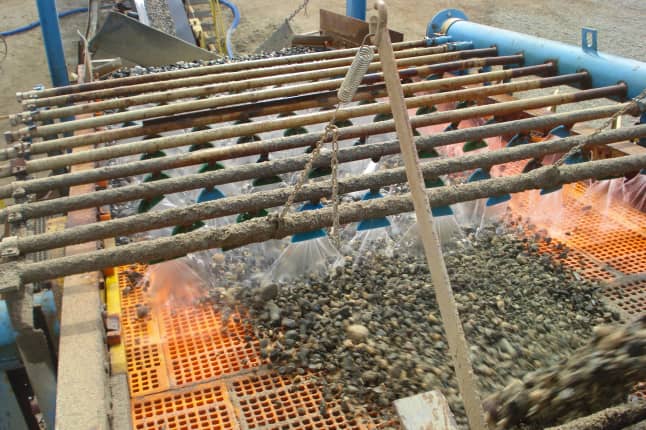
Background: An aggregate mine wash plant treats sand and gravel using a closed-loop system. Wash equipment sprays the material to rinse away contaminants where it is screened and sorted. Water is recycled using a series of settling ponds.
The problem: Solids carryover from the primary settling pond started accumulating in the secondary settling pond, eventually circulating back into the wash plant’s equipment.
The root cause was determined to be an ineffective wash water chemistry and dosing program.The solution: CarboNet tested on-site and designed a new chemistry program to optimize performance and cut cost-to-treat. Products selected include:
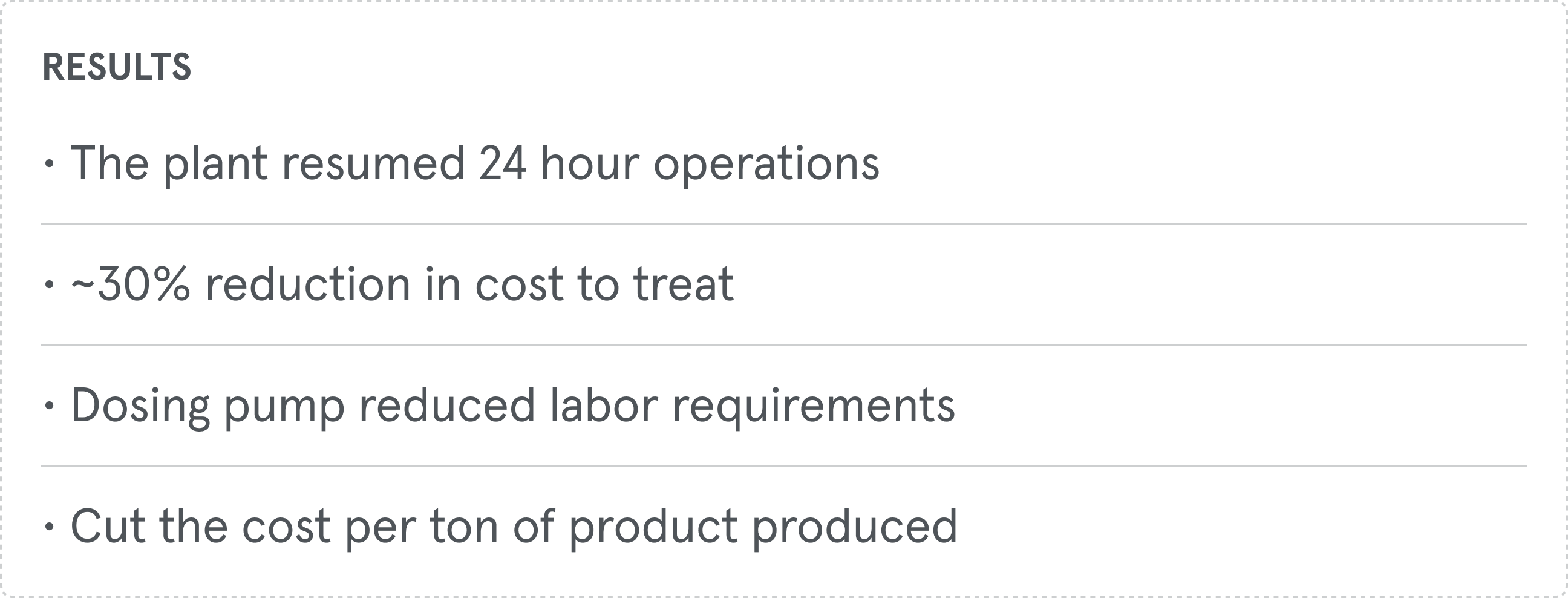
The team also installed an automated pump to replace a manual process. It modulates chemistry to reduce overdosing, and provides consistent mixing before water is recycled for reuse.The results: The mine resumed 24-hour operations with lower OPEX and CAPEX. Consistent water treatment performance allows delivery of material to the plant’s customers at a lower cost-per-dry-ton.
Every operation fights the same battle: how fast you can turn dirty water into clean water—and how much solids you can drop along the way.
CarboNet chemistry speeds up settling while giving operators control over slurry behaviour: lower TSS, clearer water back to the wash, and slurry that holds together without clogging the pond.
Less fouling. Fewer shutdowns. And chemistry that tunes to your system instead of overwhelming it.

© 2023 CarboNet. All rights reserved