

CarboNet chemistry and automated treatment adapt to changing water, tight timelines, and remote crews—cutting polymer use up to 80%, cost-to-treat 50%, and labor 35%. Site performance becomes predictable, and your jobs become more profitable.

Dewatering sediment can muck up the margins on any dredging job. The water varies minute-to-minute and flocculants regularly underperform, leaving crews struggling to keep dosing dialed.
CarboNet combines supercharged flocculants and coagulants with automated dosing to simplify operations, improve margins, and reduce environmental impact.
Why it matters: Dredgers struggle with dosing drift, equipment fouling (bag blinding), and watery cakes that spike disposal costs. Every miss adds labor or additional chemistry expense—cutting into your margins and making jobs harder to bid competitively.
CarboNet chemistry and automation solve for this:
The secret sauce: CarboNet chemistry is built on the NanoNet platform, our molecular engine for faster, cleaner, and more consistent solids removal.
Whether you’re running gels in geobags or emulsions paired with presses, NanoNets supercharge performance by reducing polymer use, improving floc strength, and shrinking sludge volume.
The bottom line: CarboNet chemistry improves dewatering performance. SpecialOps automated treatment keeps dosing in line with swings in solids. Jobs become more predicatable, and margins improve.
Automated dosing cuts costs 30% by matching swings in influent volume and TSS.
Background
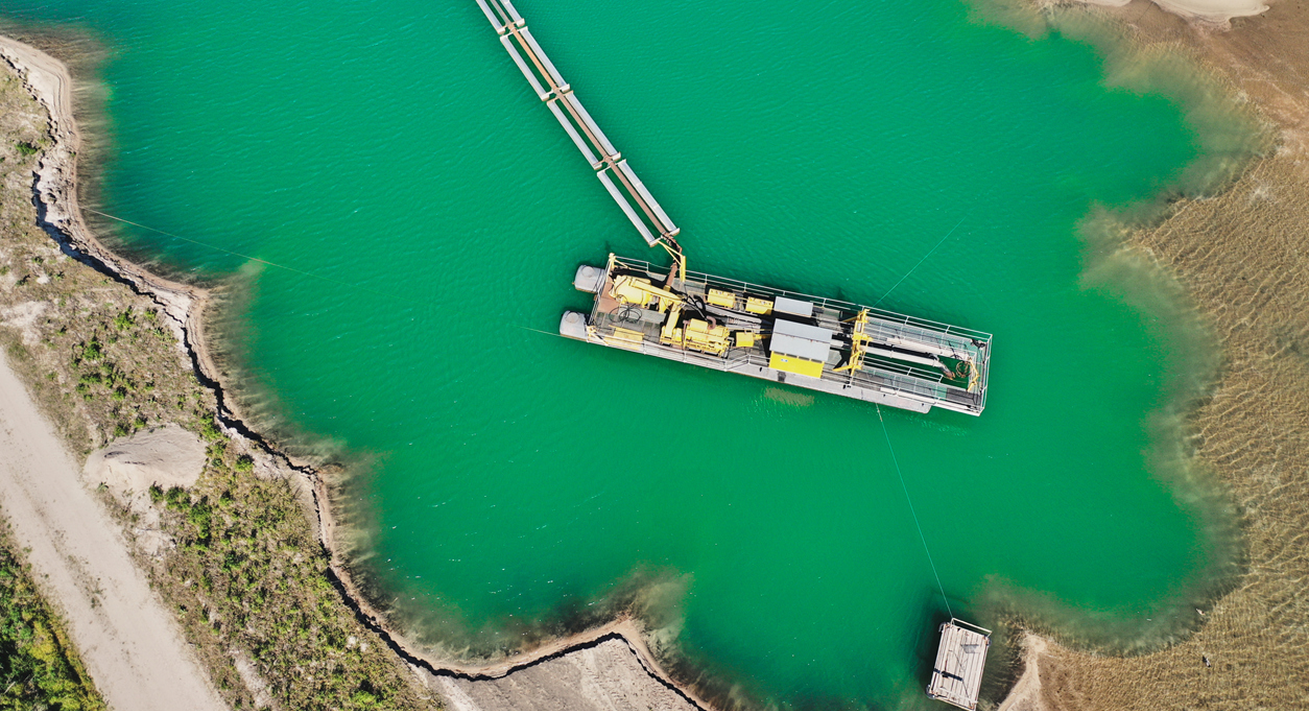
A dredging operation in Texas was tasked with removing solids from a reservoir to clear blockage from a city water plant’s inlet. Over 40,000 cubic yards of sediment needed to be removed, dewatered, and sent to the landfill.
Slurry is sent from the dredge to four centrifuges on shore by pumps. Influent flows vary depending on the dredge position and buffer tank levels, while solids content could swing from 1% to 12%. Operators did not have a reliable way of tracking flow rate or solids in real time. Instead, they needed to continuously monitor centrifuge filtrate to make rate and chemistry adjustments. This often results in high levels of chemistry applied across all conditions to be safe—significantly increasing the total cost to treat.
The problem
The team on-site was faced with a risky and time consuming balancing act. Overdosing has severe consequences when solids unexpectedly drop, leading to torque spikes that stress the centrifuges and ultimately to shutdowns.
Conversely, underdosing lets fine particles pass through and creates wet cake or dirty filtrate, jeopardizing landfill acceptance.
Approach
CarboNet deployed a two-part solution designed to simplify operations and stabilize performance:
The CarboNet field team dialed in the system during initial trials, then handed over a largely self-regulating process that could respond to field variability with minimal operator input.
Site configuration included meters for solids and flow, dosing pumps, telemetry, and a PLC integrated with an HMI. Both the site manager and CarboNet’s field team could access site data remotely through a cloud application to monitor performance by the minute.
Results
Combining high performance chemistry with automated dosing stabilized site performance, cut treatment costs, and removed the need for outsourced, specialized labor.
The site’s operators were trained and using the system independently within a week. Special Ops handled flow changes in real time without overshooting dose—reducing polymer waste and cutting total cost to treat.
With fewer hands needed to manage dosing, the site ran leaner. Operators were freed up to focus on other tasks. The site manager could monitor performance on-the-go, and was able to use Special Ops reporting data to replace a previously manual reporting processes.
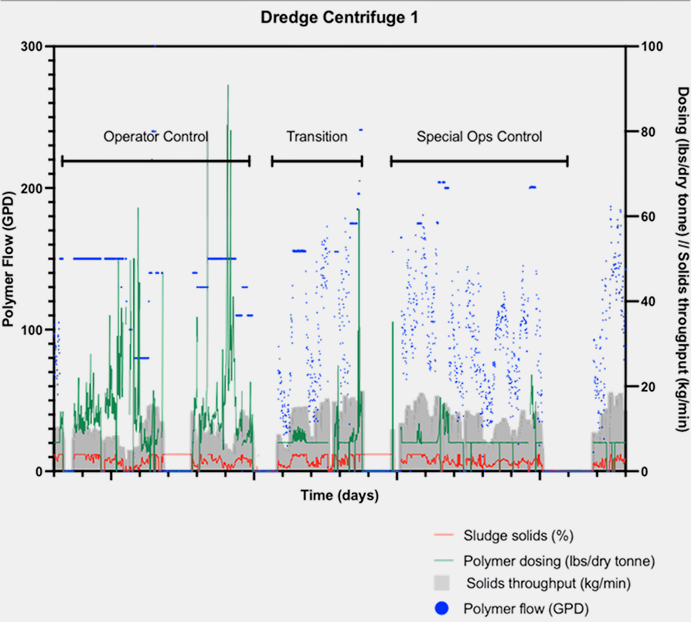
SITE DATA: GRAPH 1
The timeline below shows site performance before and after the transition to Special Ops. In the operator controlled portion on the left, dosages are set high to accommodate spikes in solids and remaining high for longer durations (blue) even when solids content drops. This led to significant increases in cost per dry tonne treated (green). As the site transitions to Special Ops on the right, dosage adjustments happen automatically to match flow rate and TSS by the minute—keeping cost to treat down and predictable (green).
SITE DATA: GRAPH 2
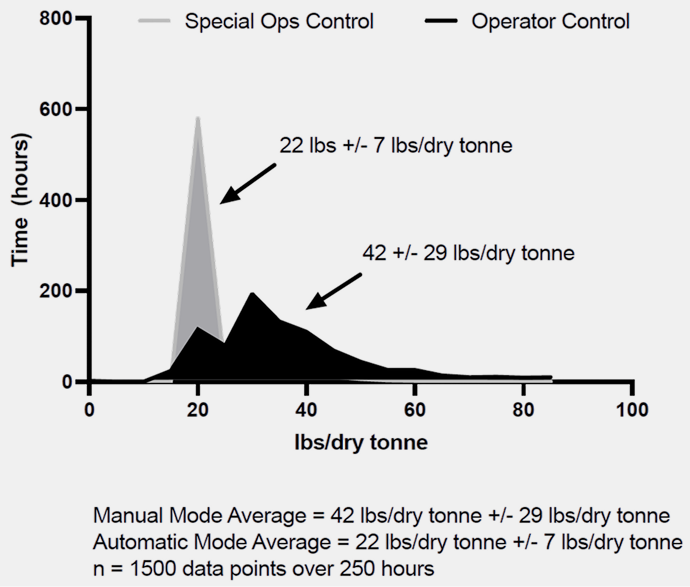
When the periods of manual and automated dosing are contrasted in aggregate, the performance in solids dewatering can be observed more succinctly. Under Special Ops control , sludge weight dropped and was more consistent under treatment compared to manual operator control.
© 2026 CarboNet. All rights reserved