Food & beverage wastewater is expensive to treat. Most producers know that. What's less obvious is how much of that cost is self-inflicted.

WASTEWATER TREATMENT SHOULD be simple: Add chemicals, separate waste, maintain compliance. Except it’s not. One day, your system is handling routine discharge. The next, a cleaning cycle, a shift in production, or a spike in organic load throws everything off balance.
Your operators roll with the punches. They measure and make adjustments.
But over time, costs start adding up—sometimes in ways that aren’t obvious. Increased sludge volumes, extra labor hours spent troubleshooting wastewater treatment, and equipment downtime for cleaning become part of the routine.
Just the cost of doing business? Not really.
Food & beverage manufacturers don’t treat a single, uniform waste stream. They treat wastewater that’s constantly changing based on ingredients, production schedules, and cleaning processes.
Plants are already feeling the squeeze. Compliance limits are tightening, treatment costs are climbing, and wastewater teams are expected to do more with fewer resources.
But here’s the part that doesn’t get talked about enough: the compounding cost of “good enough” treatment.
When wastewater treatment isn’t optimized for variability, the costs extend far beyond the chemical budget, or the regulatory fines paid out. They compound across equipment wear, and labor inefficiencies too.
At a time when cost control and labor shortages are top of mind for many producers, finding ways to do more with less is critical. Chemistry is a lever many producers can pull without overhauling their entire treatment train.
Many plants think they’re keeping costs under control because they’re locked into a low chemical price per gallon. But the real question is: How much are you spending per 1,000 gallons of treated wastewater?
Inconsistent treatment means operators are always one step behind, adjusting dosing on the fly to avoid violations. The problem is that reactive compliance is expensive. Fines are just one part of the cost—extra reporting, emergency chemical additions, and the risk of production shutdowns add up quickly.
When chemistry isn’t dialed in, unplanned maintenance becomes the norm, and production downtime tanks your COGS. Over time, plants may even shorten equipment life cycles.
Overdosing chemicals leads to more frequent manual interventions and increasing disposal costs. Every extra hour spent adjusting dosing or dealing with unexpected TSS spikes is an hour not spent optimizing the plant.
Wastewater treatment shouldn’t be a daily fire drill, but for many facilities, that’s exactly what it becomes.
We often hear that facilities have increased their production capacity without making any changes to treatment. Facilities that find ways to scale treatment efficiently (without purchasing equipment) gain a significant advantage over their competitors.
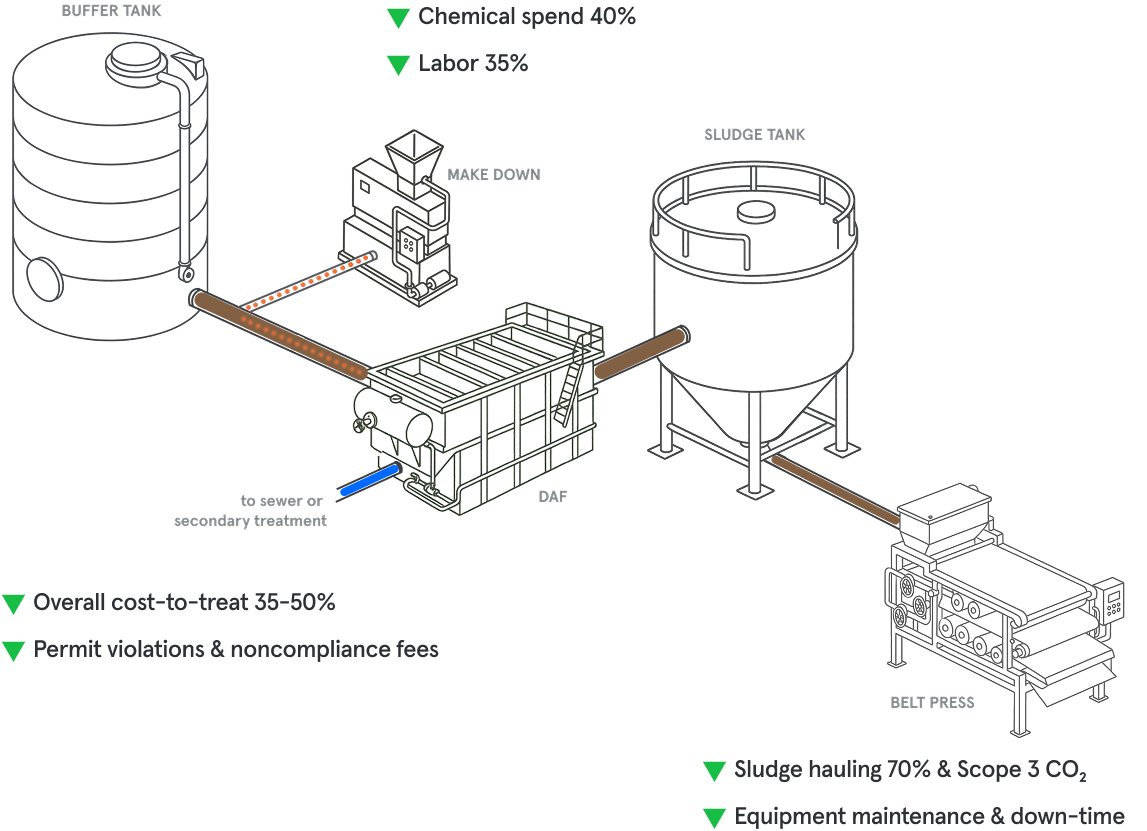
CarboNet is helping F&B producers solve these problems with NanoNets, an advanced chemistry platform that creates novel molecules to target particles in water at 10x the efficiency of legacy chemicals. NanoNet-enhanced coagulants and flocculants help our customers control the challenging influent and variational swings that come with challenging F&B wastewater.
One customer making frozen foods in Southern California struggled with high solids levels and large swings in temperature and pH. Incumbent chemistry formed weak, inconsistent flocs that couldn’t be dewatered by their screw press, forcing disposal of wet, untreated sludge.
Meanwhile, the business had committed to cutting Scope 3 emissions. They found sludge transport was a key contributor—making wastewater improvements a clear case for the P&L and the planet.
We tested a range of products to optimize their treatment performance, reliability, sludge disposal costs, and emissions, ultimately settling on SimplePrime and SimpleFloc, two NanoNet-enhanced chemicals that had an immediate impact on the water, the P&L, and the plant’s Scope 3 emissions.
The results:
Chemistry choices ripple across your entire operation. The right solution cleans up your water and your cost structure.
If you're looking to assess your wastewater treatment, here are some suggestions:
Amielle Lake is the Chief Commercial Officer and Co-Founder at CarboNet. She works with industrial producers and municipal facilities to reduce polymer use, operating costs, and emissions.
© 2026 CarboNet. All rights reserved