There is no single ‘best chemistry program’ by industry or application. What works well on one site could fail in a similar one, even if they process the same products.

SELECTING A CHEMISTRY PROGRAM for food and beverage producers must consider the primary contaminant in the water, what you’ll do with the material you remove, what equipment is used, and what Key Performance Indicators (KPI) or compliance benchmarks need to be met. The optimal treatment program will keep effluent within KPIs consistently at the lowest cost-to-treat.
Key points
Consider what you’re trying to remove from the wastewater starting with the target particle size. Are they microscopic particles that never settle out? Large, visible particles that drop to the bottom over time? What charge do they carry? Are there fats, oils and grease (FOG) present? Protein content? And what is the ambient temperature of the water?
Most importantly, consider the entire range of conditions. Production cycles, clean-in-place (CIP) discharges, and shift transitions can produce significant short-term variations in pH, temperature, and organic load.
The combination of these characteristics across operating conditions determines what type of flocculant is needed and if a coagulant is required for the polymer to work properly. Generally, producers may consider these a starting point.*
*There are exceptions which will flip these general categorizations, some examples are discussed below.
Coagulants and flocculants work as a team. Imagine the particles in wastewater as tiny magnets pushing each other apart. The coagulant helps turn down that repulsion, while the flocculant acts like a bridge that connects particles into larger flocs that are easier to remove from the water. In oily or emulsified wastewater (FOG), the coagulant also helps break the emulsion so the flocculant can work effectively.
The type of coagulant required depends on the wastewater temperature and the desired use case for the sludge at the end of treatment. For example, standard metal salts won’t perform well in cold water where hydrolysis slows down and higher water viscosity resists particle collision. We’ll talk more about sludge disposal and the impact on chemistry selection in the next section.
Among industrial manufacturers, Food & beverage categorically produces some of the highest volumes of sludge from wastewater treatment. What a facility does with their sludge adds another layer to how we think about the treatment chemistry. Mostly by eliminating certain options.
Land application as fertilizer requires eliminating pathogens and keeping nutrients bioavailable. Flocculants need to use biodegradable polymers. This ensures that when the sludge breaks down in the soil, it does not leave behind tough, synthetic chemical webs that could alter soil micro-biology. Coagulants like Aluminum Sulfate (Alum) should be avoided because they trap phosphorus, blocking the value of the fertilizer. Instead, select organic coagulants or iron salts.
Recovering protein for additives requires flocculants and coagulants that are food-grade, non-toxic, and safe for consumption.
Disposal in a landfill requires meeting local and federal regulations, and optimizing the dewatering performance to minimize transportation and disposal costs.
Chemistry also needs to account for the mechanical shear and compression forces of the treatment equipment. These impact the physical strength and molecular architecture of the chemistry required.
Shear determines whether a high-molecular-weight linear polymer is sufficient or if you must switch to a cross-linked architecture where the interconnected 3D web protects the flocs from being torn apart.
Lower-shear thickening equipment such as dissolved air flotation (DAF) units, gravity thickeners, and rotary drum thickeners often perform well with high-molecular-weight linear polymers designed to maximize floc size and solids capture.
Higher-shear dewatering equipment such as belt presses, screw presses, and centrifuges more frequently benefit from structured polymers that produce stronger, more shear-resistant flocs capable of maintaining drainage under mechanical stress.
Compression determines the required structural elasticity and rigidity of the floc. High compression forces, like those in dewatering, favor more structured polymers because their 3D sponge-like network acts like a spring. It can be crushed under tons of pressure while maintaining microscopic drainage channels so water can escape.
After establishing key general characteristics to the flocculant and coagulant choices, bench-scale jar tests are used to fine-tune the approach (dose, charge density, molecular weight) within KPIs. Those that are impacted by flocculant and coagulant selection / performance include:
Regulatory KPIs
Operational KPIs
The steps and decision branching involved in bench testing depends on the application (clarification vs sludge dewatering), the types of chemistry being tested, and the treatment equipment. The nuance of these combined variables merits a detailed guide. Also, the results produced in a bench test environment can be challenging to get to replicate at production scale.
CarboNet’s product implementation specialists have designed case-specific workflows for chemistry selection in a variety of Food & Beverage settings that ensure producers get consistent and repeatable results. Contact our team for a free consultation. We’ll send you a sample kit, or come on-site to test.
CarboNet develops flocculants and coagulants that improve treatment performance and reduce overall cost-to-treat for food and beverage producers. SimpleFloc flocculants are enhanced by NanoNet technology which improves clarity and solids capture with less active polymer.
Reference cases
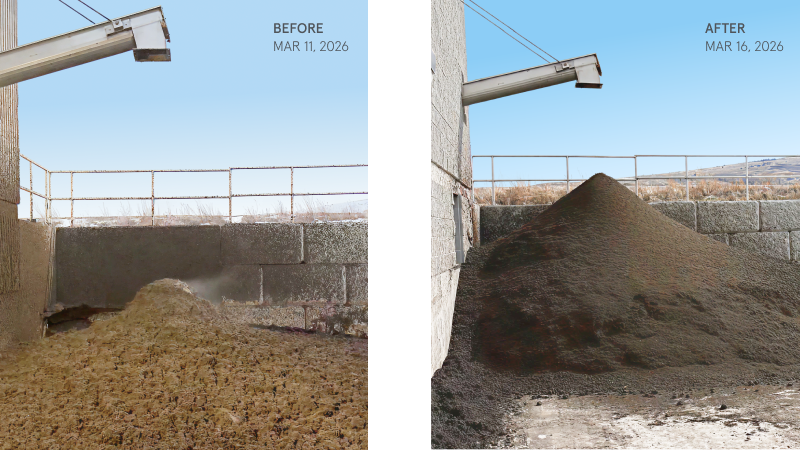
A frozen food manufacturer had chemistry that formed weak, inconsistent flocs that resisted screw press dewatering, made worse by big swings in influent temperature and pH. Switching to CarboNet chemistry dropped sludge volume 75%, saving roughly $800,000 a year in haul-off.
A dairy processor switched to keep TSS in KPI during high-flow periods. SimpleFloc achieved better solids capture, improved cake dryness, and lowered the chemical costs by about 13%.
A wine producer could not meet KPIs during harvest season when solids spiked. Switching to CarboNet chemistry brought effluent levels back into spec while saving the producer 20-25% in treatment costs and reducing 4.9M gallons of water use annually.
Amielle Lake is the Chief Commercial Officer and Co-Founder at CarboNet. She works with industrial producers and municipal facilities to reduce polymer use, operating costs, and emissions.
© 2026 CarboNet. All rights reserved