Discharge treatment programs for construction and dredge dewatering can have a significant impact on a project’s P&L. Understanding the regulations at play, and how to match chemistry to your unique water is critical to designing treatment programs that perform to spec and minimize cost without damaging ecosystems.

CONSTRUCTION AND DREDGE DEWATERING treatment solve for similar properties: turbid, solids-laden, usually carrying sediment-bound metals and nutrients, sometimes legacy contaminants from the material being moved. The main difference we’ve seen are the requirements for discharging that water from one jurisdiction to the next. It can have significant implications for how you design a treatment program, especially the chemistry you choose.
A program that is compliant in one state can require prior approval and engineered controls in the next, and can be unlawful near fish-bearing water across the Canadian border. If you perform construction dewatering or dredge water treatment in more than one region, it is critical to know the regulatory landscape and how to choose chemistry that is safe and effective.
Getting it wrong can rack up fines. One recent violation in Canada cost $650,000.
Our work at CarboNet has taken us to construction and dredge dewatering sites across the United States and Canada where we select and implement chemistry programs that optimize performance, reduce operating costs, and take compliance risk out of the equation for our partners.
What follows is how we think about designing treatment programs to meet regulatory parameters, satisfy KPIs, and minimize cost to treat.
What regulations apply when dredging an industrial wastewater lagoon in Texas differ a great deal from dewatering a construction site near a river in British Columbia. Requirements are often layered, with federal, state or provincial, and local permits each with their own conditions on how the work is performed and / or monitored. Rather than get into the nuance of layered permitting, we’ll focus on what is common across them and what specifically changes based on the two primary chemistries used on these jobs: polymers and coagulants.
Common elements to the regulatory guidelines in the US and Canada include:
POLYMERS
In construction and dredge dewatering treatment, the selection between anionic and cationic polymer is both the most significant performance decision and the most significant regulatory one.
Cationic polyacrylamides and similar positively charged polymers are more effective at removing negatively charged fine clays and solids. However, federal and state / provincial regulations across the United States and Canada mandate that any additive used cannot cause toxicity to aquatic life. And because cationic polymers bind to the negative charges on fish gills and suffocate them, many jurisdictions outlaw them entirely.
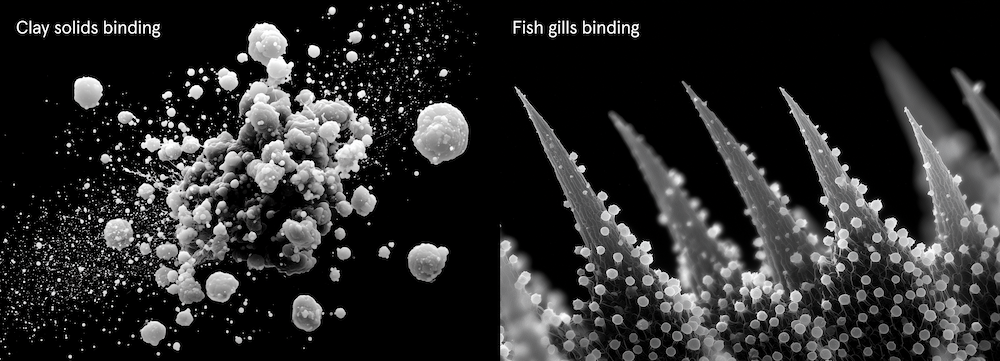
In the US, many states maintain strict, pre-approved lists of which dewatering chemicals are allowed. Mostly anionic polymers or natural alternatives like chitosan. If a chemical is not on that list due to toxicity concerns, you cannot legally use it, no matter how efficient it is at removing Total Suspended Solids (TSS).
In more permissive regions with limited chemical regulation, polymer selection may be governed mainly by the operator's judgment and the turbidity result. In Washington, and in any Canadian jurisdiction near a fish-bearing water, the polymer itself is regulated, and clarification of the water is not sufficient if the chemistry or its residual is deleterious.
COAGULANTS
Most dewatering and dredge programs also use a coagulant. Common coagulants are aluminum-based (alum, or aluminum sulfate, and polyaluminum chloride) and iron-based (ferric chloride or sulfate). Their toxicity follows different rules, governed by pH and speciation rather than charge density.
The regulations that affect coagulant choice also vary by state and province, mainly due to the classification of water you will be discharging into.
There is no single best approach to treating these waters. Suppliers and practitioners will favor different chemistries and configurations, jurisdictions accept different methods. However, some common best practices hold true in many scenarios:
Moving from bench-scale to production comes with its own set of considerations and challenges. Bench testing helps decide a few variables in advance, but it does not reproduce the field hydraulics. Your flow rate, velocity, turbulence, contact time, temperature, and water chemistry all affect the delivered dose and the residual. Doses set on the bench need to be confirmed in the field with monitoring and, where required, a bioassay on the actual effluent.
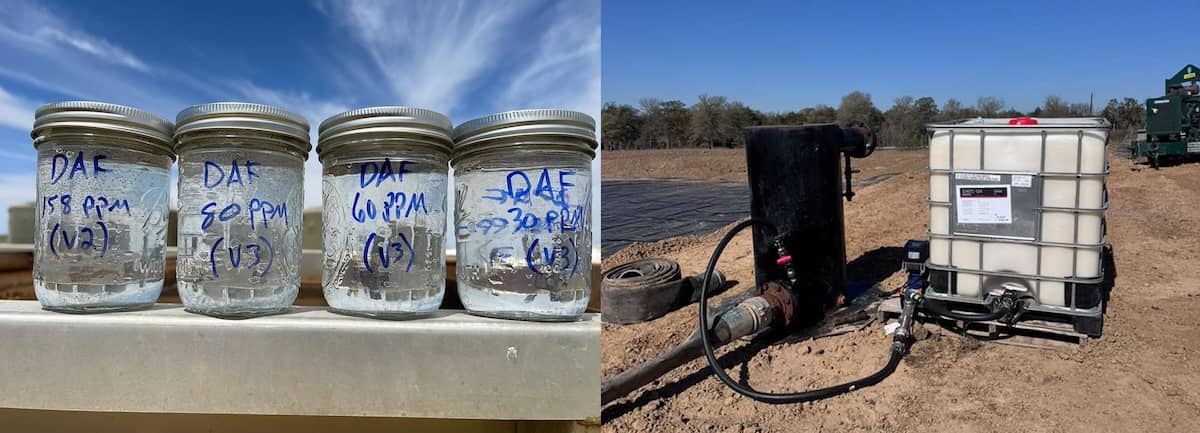
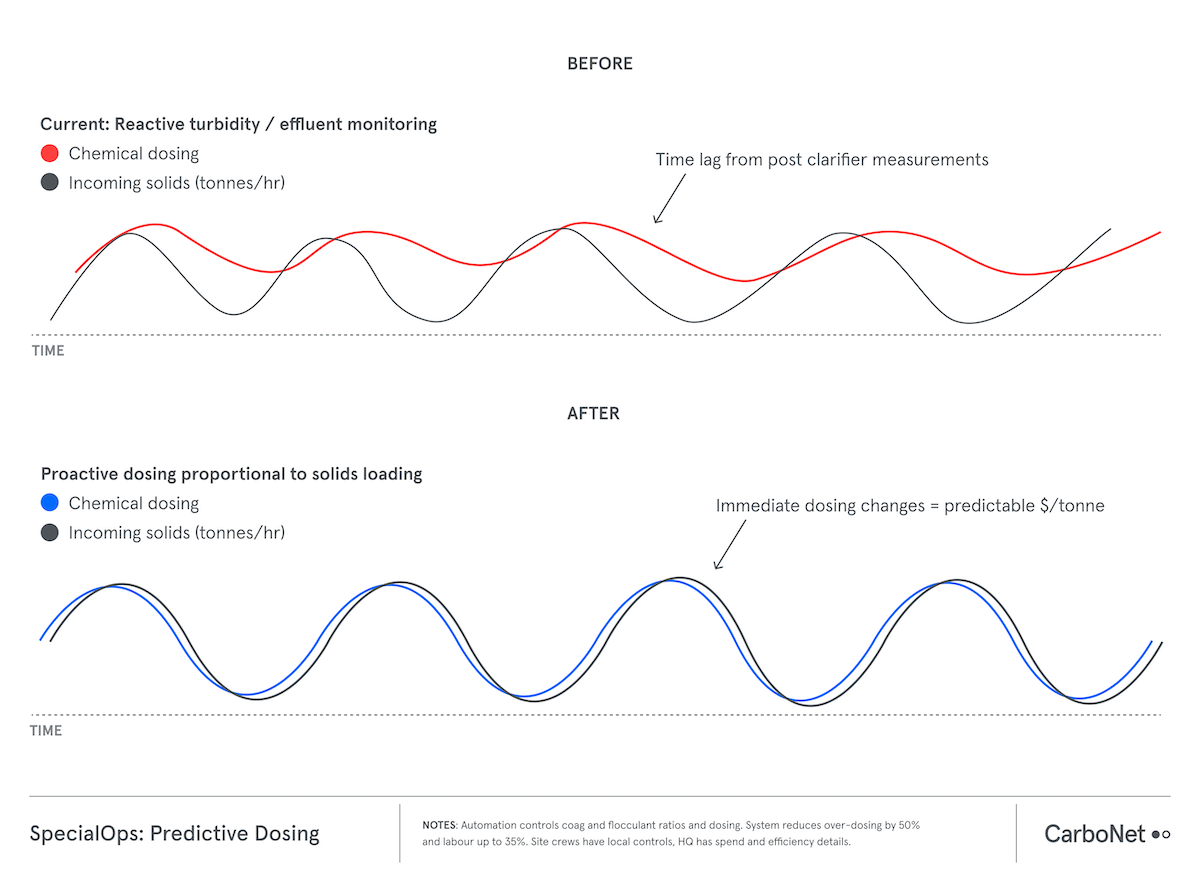
Dosing equipment must be sized to the actual flow range, not just the flow observed on the day the bench sample was pulled. A pump and injection point calibrated to one condition will over-deliver or under-deliver as solids swing. Real-time solids and flow monitoring is what makes the dose response visible; without it, drift is only detected after the fact, in torque, filtrate, cake quality, or a discharge violation.
The bench number is therefore a starting bracket, not a set point. Implementation should begin with a short calibration period in which the dose is adjusted against actual system response (filtrate clarity, cake or bag drainage, mechanical load) before it is set. Operators running the system need to know what to watch during that period and be authorized to adjust dosage, since the value of real-time monitoring depends on someone responding to system changes.
Again, approaches differ. Some sites will have more or less of this process automated. Manual adjustment against observed conditions can work where flow is relatively stable and the margin for error is wide. Where solids are highly variable or the discharge point is sensitive, automated feedback control removes the lag between a change in the water and a change in the chemistry, which is where most bench-to-production shortfalls originate.
Stricter permits will specify monitoring and dosing control in more detail. For example, Washington’s chitosan-enhanced sand filtration approvals require continuous influent and effluent turbidity and pH monitoring with automatic shutdown when readings move out of range. California's active-treatment rules require effluent turbidity logged at 15-minute intervals, residual-chemical and toxicity monitoring, automatic shutoff or recirculation on any exceedance or power failure, and dosing controlled by flow- and turbidity-proportional metering with streaming-current (ionic charge) feedback. These examples are specifications for an automated monitoring and dosing system.
CarboNet treats these compliance challenges as a chemistry problem and an automation problem. We use the NanoNet platform to create performance-tuned polymers and coagulants that are programmable at scale, targeting specific particle types, enhancing floc strength, and optimizing dose efficiency.
NanoNet chemistry targets and sequesters problem particles more precisely, which lowers the dose needed to hit a given clarity and residual target. That matters directly for the residual-toxicity problem: a molecule engineered to bind its target more completely leaves less unreacted polymer in the effluent at the same treatment result, which is the variable the acute-lethality test is checking. NanoNet chemistry is also less sensitive to swings in solids and flow than commodity polymer, which narrows the dose range automation has to correct for in the first place.
Pairing that chemistry with CarboNet's Special Ops automated dosing takes it a step further with three control modes correspond to the regulatory requirements:
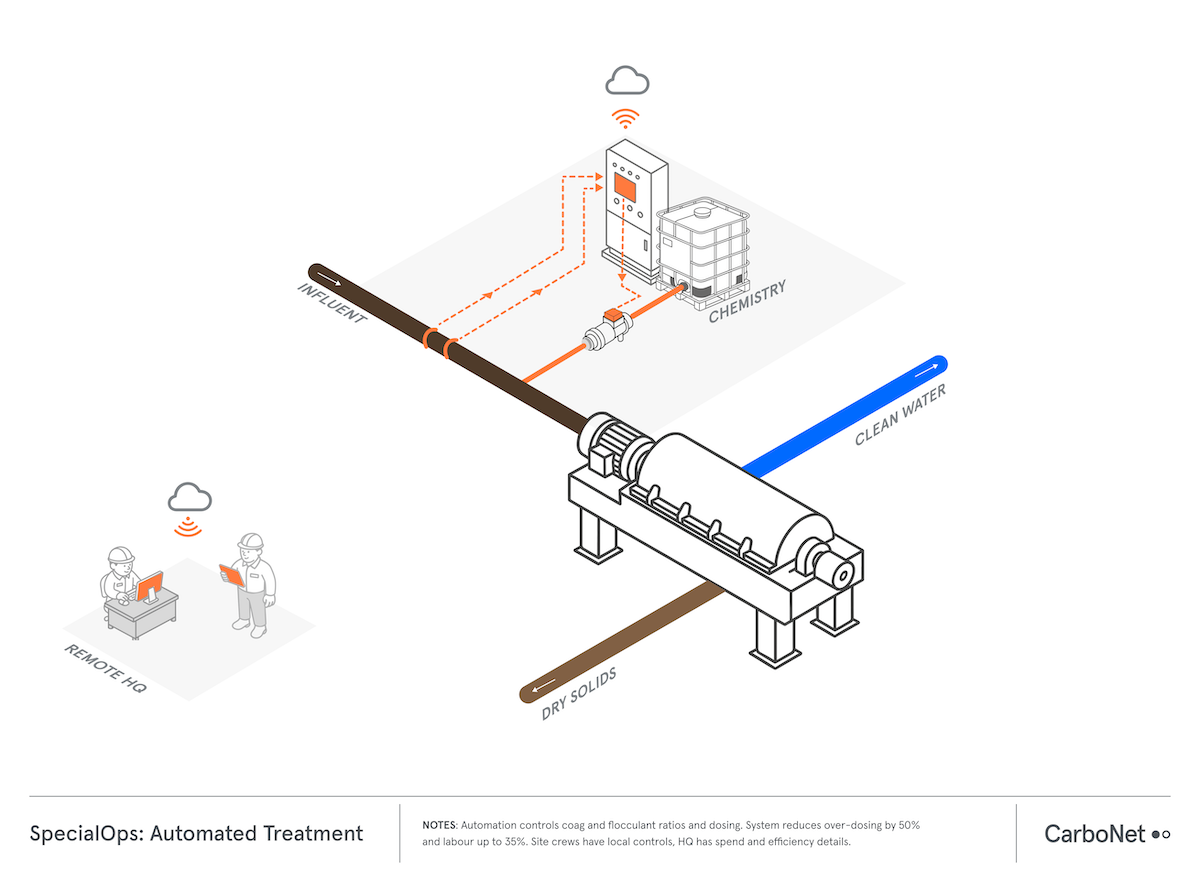
Knowing the nuances of federal and regional regulations, as well as how to match chemistry programs and leverage automated dosing strategies to suit site conditions can have significant impact on a site's dewatering cost-to-treat. Especially when that means avoiding costly fines from residuals impacting wildlife.
Through our work with construction and dredging site managers, we’ve learned that the details of dewatering can have a major impact on their business. For example, one dredger we’ve worked with in Texas gained confidence to bid larger jobs more aggressively after dialing in their dewatering process. Having more certainty around dewatering capabilities and being able to reduce the cost of the result becomes a competitive advantage.
Dr. Michael Carlson holds a PhD in Biochemistry. He co-founded CarboNet and, as Chief Technology Officer, currently leads the company’s research and scientist recruitment efforts.
© 2026 CarboNet. All rights reserved