NanoNets are what makes CarboNet chemistry unique. They create performance-tuned flocculants and coagulants that target specific particle types, enhance floc strength, and optimize dose efficiency.

COMPARED TO TRADITIONAL CHEMISTRIES, NanoNet-enhanced formulations improve performance across a wider range of water conditions and reduce overall cost-to-treat. But what underlying mechanism drives those results?
This is best explained by comparing a traditional flocculant to one enhanced by NanoNets, SimpleFloc, by the bridging mechanism all flocculants use.
Flocculants are long polymer chains that adsorbs onto particles in water and link them together. This mechanism is called bridging. The aggregates that form from bridging are large enough to be separated from the water by settling, thickening or dewatering.
Traditional flocculants differ from one another by how the polymer chain is built. The charge, molecular weight, charge density, and structure are selected according to the use case, such as sludge dewatering or clarification, thickening or raw water flocculation. That’s because the feed, the solids and the equipment each require something different of the floc being formed.
NanoNets introduce a new supporting component to the polymers in flocculants which boost the performance. The context of that ‘boost’ requires understanding where polymers struggle.
Polymers in traditional flocculants are prone to coiling, where the long molecular chains prematurely collapse and wrap tightly around themselves or a single particle rather than stretching out to bridge multiple solids. This limits the polymer’s capacity for bridging.
In addition to coiling, the active sites on polymer chains are easily intercepted and neutralized by background water impurities, high salinity, or competing organic matter before they reach the actual target contaminants. This can result in weak, or loose flocs that contain bound water and are easily sheared by mechanical forces.
In practice, both factors mean a higher dose is required to achieve KPIs which increases chemical costs and can lead to a higher frequency of equipment blinding or fouling requiring more operator interventions from excess polymer use.
Nanonets are a secondary active chemical that we incorporate into the flocculant package. Nanonets support the binding and bridging capacity of a polymer by targeting wastewater impurities that block polymer binding sites, leaving more polymer sites open for binding. They also facilitate weak flocculation between wastewater particles, allowing the polymer to form strong binding and bridging of wastewater particles.
The result is an enhanced polymer chain that isn’t as easily intercepted, maximizes its surface area, and binds to target particles with improved strength. Flocs from NanoNet enhanced polymers contain less bound water and hold up to higher shear force.
Flocculation is more efficient and can be achieved with less active polymer, which has significant impact to treatment programs.
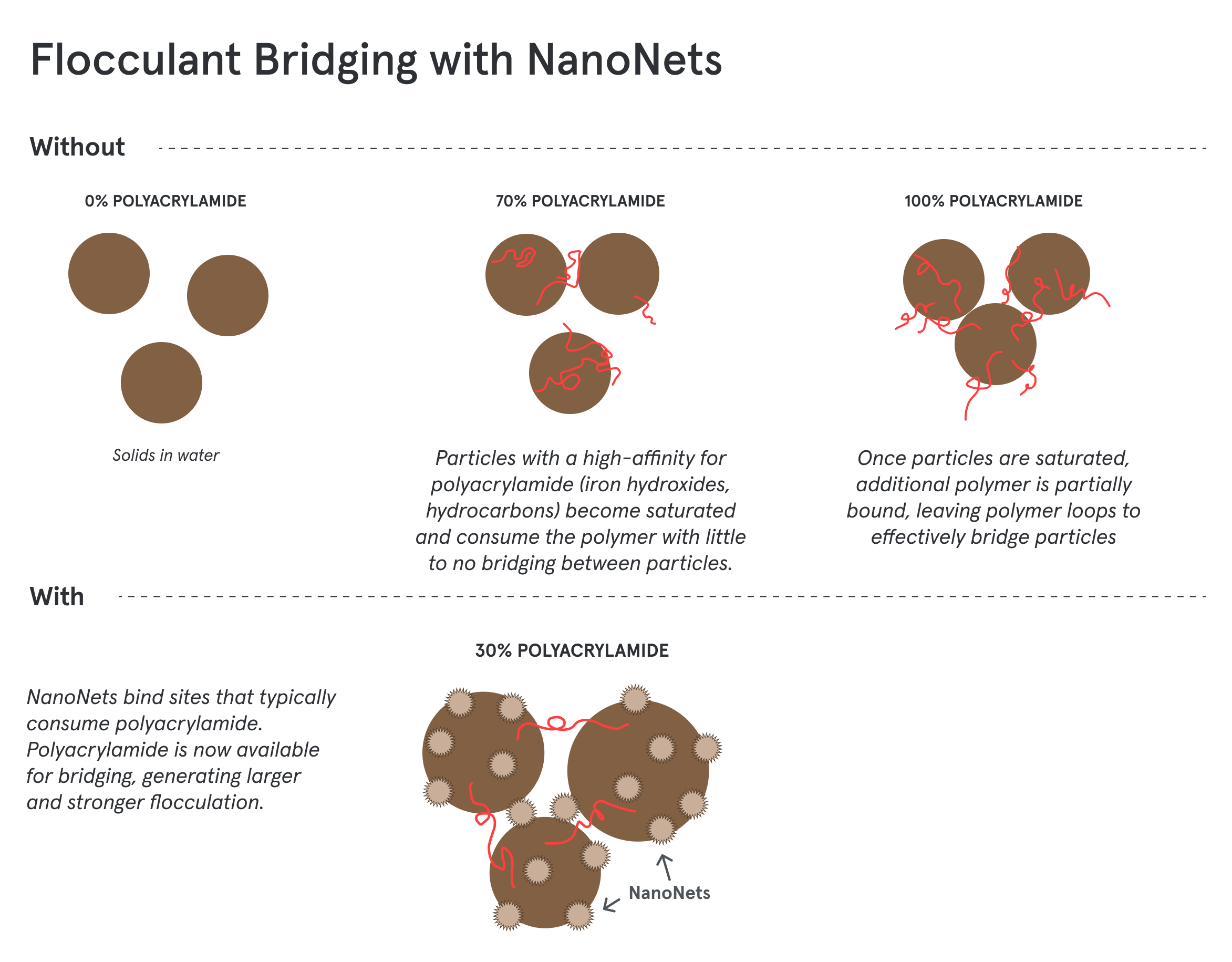
NanoNets can directly impact operating costs and equipment bottlenecks by changing three things.
Drier cake: NanoNets reduce bound water and improve shear strength allowing the same mechanical dewatering equipment to squeeze out significantly more moisture (read the reference case). This can reduce hauling costs or on-site storage footprint.
Sludge penetration and TSS capture: Because NanoNets target sites in the desired particles, they improve penetration into the sludge and the capture of suspended solids. This helps reduce compliance issues or surcharges (read the reference case).
Less active polymer in the final solids: The active polymer content in a NanoNet enhanced formulation is far lower and binds more efficiently, so there is less residual polymer in the dewatered solids. This reduces equipment blinding or fouling events and improves compliance capabilities (read the reference case).
A flocculant’s performance was previously improved by changing the polymer: higher molecular weight, different charge, more structure. Much of what now separates one supplier from another is price, largely dictated by the logistics in supplying the product. Dewatered emulsions, slurries, rail shipping and local warehousing all lower the cost of moving water around, but none of them change what the polymer does when it reaches the sludge.
NanoNets change that pattern by adding a supporting chemical to the range of available chemistries which makes them more efficient, and more cost-effective.
This requires a new comparison context, shifting from an apples-to-apples unit price mindset to what the impact is on your overall cost-to-treat: chemistry costs, downtime and maintenance, labor, compliance or surcharges, and disposal costs.
Amielle Lake is the Chief Commercial Officer and Co-Founder at CarboNet. She works with industrial producers and municipal facilities to reduce polymer use, operating costs, and emissions.
© 2026 CarboNet. All rights reserved